The Final Countdown To...

Showing posts with label Black History Month. Show all posts

Tuesday, February 12, 2013

Black History Month - Bessie Coleman - 2/12

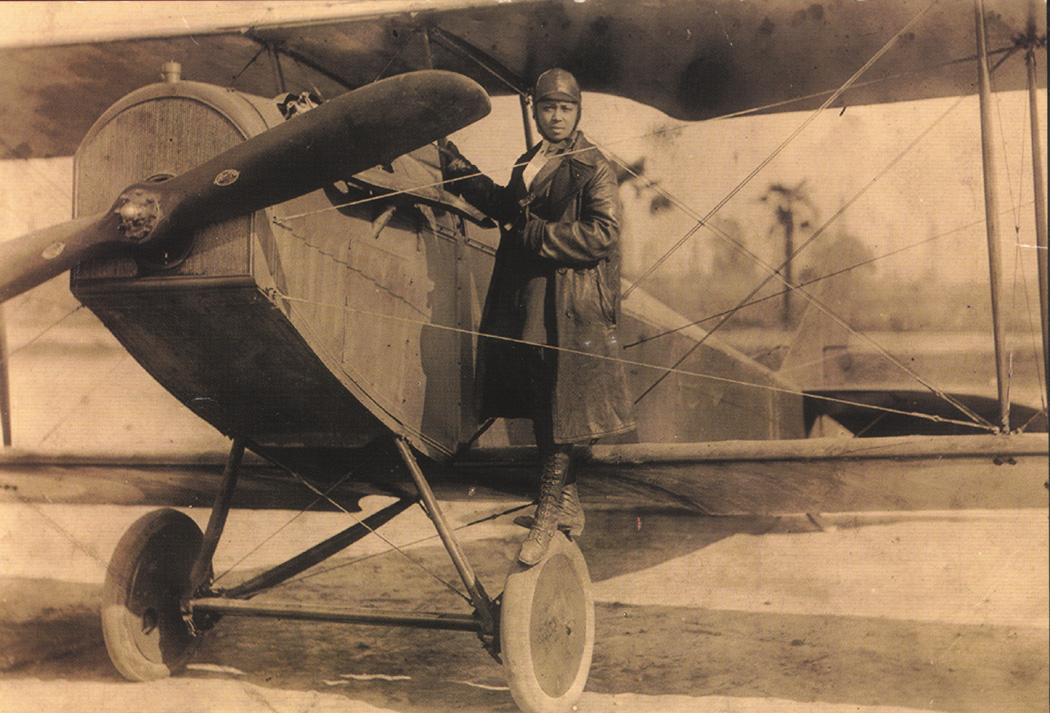
Elizabeth "Bessie" Coleman is the first African American to hold an international pilot's license. The fact that she's a woman, in a time when virtually all aviators were men, makes her achievements all that more remarkable. 
Coleman and her plane

Born in 1892, in the Jim Crow South, Coleman was the 10th of thirteen children.  Her father was a sharecropper in Atlanta, Texas, and also part Cherokee. Coleman attend a one-room school house, but also participated in the cotton harvest.  Unfortunately, her father returned to Indian Territory (Oklahoma), abandoning his family when she was just 9.

At age 23, Coleman, like many African Americans in the period of 1910-1930, moved North in what was known as the 1st Great Migration.  Settling in Chicago, Bessie Coleman was one of 1.6 million migrants who left mostly rural areas to migrate to northern and Midwestern industrial cities.

She was inspired to fly by the stories of pilots returning from World War I.  However, nobody, not even African American pilots would train her.  In the end, she was trained in France in 1921, earning that international pilot's license.

From there, Bessie began working in air shows.  She truly enjoyed stunt flying.  Through her media contacts, she was offered a role in a feature-length film titled Shadow and Sunshine, to be financed by the African American Seminole Film Producing Company. She gladly accepted, hoping the publicity would help to advance her career and provide her with some of the money she needed to establish her own flying school. However, when she learned that a scene in the film took a stereotypically racist view, she left the film.

In 1926, while preparing for an air show, Coleman's manager and she had a flight accident.  Looking over the edge of the cockpit, not wearing her seat belt  Coleman was preparing for a parachute jump.  When the plane began to spin out of a dive, Coleman was thrown from the plane.  She fell to her death from 2000 feet.  The pilot that day, William Wills was unable to gain control of the plane. He died upon impact. The plane became an inferno.  Although the wreckage of the plane was badly burned, it was later discovered that a wrench used to service the engine had slid into the gearbox and jammed it.

To learn more, hear what our pals, Sarah and Deblina at The Stuff You Missed in History Class Podcast had to say about The Daredevil Aviatrix: Bessie Coleman.

Coleman's International Flight License


Wednesday, February 6, 2013

Black History Month - February 06 - Otis Boykin


Otis Boykin invented electronic control devices for guided missiles, IBM computers, and the control unit for a pacemaker.  Boykin was born on August 29, 1920, in Dallas, Texas. He graduated from Fisk College in 1941. Afterwards, he took job with the Majestic Radio and TV Corporation and later the Nilsen Research Laboratories.  According to A&E, "Boykin, who took a special interest in working with resistors, began researching and inventing on his own." Later, in June, 1959, he received a patent for a wire precision resistor.. This resistor were used in both radios and televisions. In 1961, he developed a resistor that could handle extremes in temperature and pressure. "The device, which was cheaper and more reliable than others on the market, came in great demand by the United States military and IBM.  In 1964, Boykin moved to Paris, creating electronic innovations for a new market of customers. His most famous invention was a control unit for the pacemaker. Ironically, Boykin died in Chicago in 1982 as a result of heart failure. Upon his death, he had 26 patents to his name."

Otis Boykin is best known for inventing an improved electrical resistor used in computers, radios, television sets and a variety of electronic devices. His resistor helped reduce the cost of those products. Otis Boykin also invented a variable resistor used in guided missile parts, a control unit for heart stimulators, a burglar-proof cash register and a chemical air filter.

Tuesday, February 5, 2013

Black History Month

Today, in 1884, Willis Johnson patented the rotary egg-beater.
Johnson, an African American from Cincinnati, invented the above machine.  It was a complex machine designed to help scramble eggs, mix batter, and blend other foods.  The two-chambered device actually allowed for eggs to be beaten in one area, while batter could be mixed in another.  This invention revolutionized the baking industry.  Prior to this, device made up of a handle attached to a series of spring-like whisk wires used to help mix ingredients. Prior to his eggbeater, all mixing of ingredients was done by hand.and was quite labor-intensive and time-consuming.

Wednesday, February 8, 2012

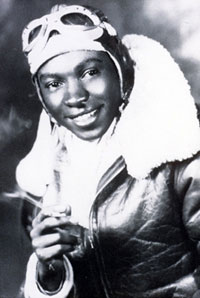
Tuskegee Airmen - American Heroes

The Tuskegee Airmen are a testament to fortitude and heroism.  During World War II, the Tuskegee Institute trained civilian pilots in the first program of its kind.  These men overcame segregation and discrimination to prove the abilities of African American pilots.  They helped pave the way for full integration of the military.


To learn more, visit the National Parks' Service tribute to this program: http://www.nps.gov/museum/exhibits/tuskegee/airoverview.htm

Thursday, February 2, 2012

'Henrietta Lacks': A Donor's Immortal Legacy

Henrietta Lacks died in 1951 of cervical cancer; aged 31 years, and the mother of 5 children.  Yet, at the same time, she has continued to live by her unknown donation to the medical field.  Her legacy is one of healing.  That is why I have chosen to have Henrietta Lacks as our first Black History Month post, for her contributions to humankind over the past 60 years.


Henrietta's legacy is the HeLa cell. According to Wikipedia, "HeLa cell (also Hela or hela cell) is a cell type in an immortal cell line used in scientific research. It is the oldest and most commonly used human cell line.  The line was derived from cervical cancer cells taken on February 8, 1951, from Henrietta Lacks, a patient who eventually died of her cancer on October 4, 1951. The cell line was found to be remarkably durable and prolific as illustrated by its contamination of many other cell lines used in research."  It has also been used for research and development of treatments and cures for numerous diseases.  


To learn more about this woman's remarkable story, visit-
'Henrietta Lacks': A Donor's Immortal Legacy : NPR:

'via Blog this'

or watch...