John Green and the folks at Crash Course do an excellent job discussing the settlement of Dutch New Netherland (New York, after Peter Stuyvesant gave up!), and the English proprietary colony of Pennsylvania. It's a good review, and helpful in an entertaining way. Enjoy, and you might just learn something.
Showing posts with label review. Show all posts
Showing posts with label review. Show all posts
Thursday, August 15, 2013
Thursday, August 1, 2013
Supplemental: When is Thanksgiving? Colonizing America: Crash Course US History #2
John Green and the folks at Crash Course do a nice job of reviewing chapters 2 and 3 in a visually stimulating, and entertaining way. It also is really really informative. Enjoy!
Tuesday, July 23, 2013
Supplemental: Slavery - Crash Course US History #13
Again, Slavery and its Legacy in North America is one of our major themes. This gives a complete overview of slavery in the United States (which is really our focus). Since you are now familiar with Jamestown, the introduction of slaves in 1619, and the like, please consider this video. Though not required viewing, it will be quite helpful in the long run of the APUSH course.
Supplemental: Interesting history about the Southern Colonies

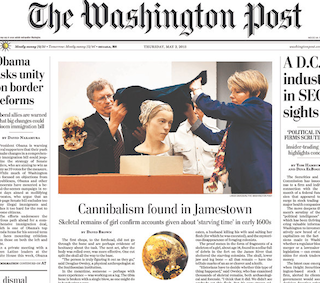
Jamestown: Cannibalism at Jamestown? On May 1, 2013, forensic evidence confirmed what survivors had reported: Colonists at Jamestown resorted to cannibalism during the winter of 1609-1610, known as the Starving Time. But the colony of Jamestown was troubled from the start.
There's also the Shipwreck that Saved Jamestown. When a relief mission left Plymouth in 1609 to assist the troubled colony of Jamestown, an intense storm separated one vessel from the rest of the fleet. Learn how this shipwreck may have saved Jamestown -- and inspired Shakespeare -- in this podcast.
Saturday, July 13, 2013
Supplemental: The Atlantic Slave Trade: Crash Course World History #24
Slavery and Its Legacy in North America is one of the major themes of APUSH. Because you are at a point when the Atlantic Slave Trade affected the era we're studying, I felt it essential to give you this overview. It's not a lot of time, so watch when you get a few minutes.
John Green teaches you about one of the least funny subjects in history: slavery. John investigates when and where slavery originated, how it changed over the centuries, and how Europeans and colonists in the Americas arrived at the idea that people could own other people based on skin color.
Slavery has existed as long as humans have had civilization, but the Atlantic Slave Trade was the height, or depth, of dehumanizing, brutal, chattel slavery. American slavery ended less than 150 years ago. In some parts of the world, it is still going on. So how do we reconcile that with modern life?
John Green teaches you about one of the least funny subjects in history: slavery. John investigates when and where slavery originated, how it changed over the centuries, and how Europeans and colonists in the Americas arrived at the idea that people could own other people based on skin color.
Slavery has existed as long as humans have had civilization, but the Atlantic Slave Trade was the height, or depth, of dehumanizing, brutal, chattel slavery. American slavery ended less than 150 years ago. In some parts of the world, it is still going on. So how do we reconcile that with modern life?
Sunday, August 12, 2012
Summer #4-Columbus/Lies My Teacher Told Me
 |
| Columbian Exchange - The positives and negatives of the Age of Exploration |
To help students in the 2011-2012 APUSH class make sense of Chapter 2 in Lies my Teacher Told Me (1493-The True Important of Christopher Columbus), answer any or all of the following questions. Do not hesitate to ask your own questions, or even to question or comment on something one of your classmates may post. The only things to remember are to avoid text-like phrasing, and to remain polite.
As you read through 1493 in Lies...
*One question I had about what I read was....
*What were you thinking about as you were reading?
*What question(s) can you ask about what you read?
*While I read, I was curious about...
*What words or ideas need clarifying for you?
*What does the author want me to remember or learn from this passage?
*What is the most important information in this passage?
*What kind of “teacher” question can I ask about the main idea?
*In my own words, this is about ...


Friday, May 4, 2012
"Study Stacks"
The resources of a study stack provide students with quick review. What's nice is, these are already created, and have short (4 cards) and long (93 cards, 155 cards, etc.) stacks of review cards. There are APUSH stacks, as well as just general US History stacks. These could be helpful for quick review. Sorry, this resource can't be embedded like the other review games that were previously posted. Instead, one of those sets will be embedded, instead. Enjoy!

Thursday, May 3, 2012
APUSH Thematic Review: Migration and Immigration in US History
The following test review outlines are published in the AP US History Crash Course*. These outlines cover themes in American history. This set examines the influence of migration in various parts of American history: Colonial, antebellum, late 19th century, and 20th century. Additionally, it examines American migration from the push across the Appalachian Mountains (during the colonial era), to westward expansion and Manifest Destiny, the Great Migration, and the move from the "Frostbelt" to the "Sunbelt."
For your review: Thematic Review 9 American Migration and Immigration to America
*Krieger, Larry. AP US History Crash Course. Piscataway, NJ: Research & Education.
For your review: Thematic Review 9 American Migration and Immigration to America
*Krieger, Larry. AP US History Crash Course. Piscataway, NJ: Research & Education.
Wednesday, May 2, 2012
APUSH Exam Thematic Review: Acts of Congress
The following test review outlines are published in the AP US History Crash Course*. These outlines cover themes in American history. This set examines Acts of Congress, beginning w/ the 2nd Continental Congress.
For your review: Thematic Review 8 Twenty Key Acts of Congress
*Krieger, Larry. AP US History Crash Course. Piscataway, NJ: Research & Education.
Acts &; Proclamations - Ignite Learning
For your review: Thematic Review 8 Twenty Key Acts of Congress
*Krieger, Larry. AP US History Crash Course. Piscataway, NJ: Research & Education.
Acts &; Proclamations - Ignite Learning
Tuesday, May 1, 2012
APUSH Exam Thematic Review: Labor Issues in American History
The following test review outlines are published in the AP US History Crash Course*. These outlines cover themes in American history. This set examines the influence of labor on American society, culture, and politics. It explores the significant labor unions, strikes, and labor laws that have affected the United States.
For your review: Thematic Review 7, Labor
*Krieger, Larry. AP US History Crash Course. Piscataway, NJ: Research & Education
Lesson - The Origins of the Labor Movement
Labor History in America - A Pictorial Documentary of Labor Issues
For your review: Thematic Review 7, Labor
*Krieger, Larry. AP US History Crash Course. Piscataway, NJ: Research & Education
Lesson - The Origins of the Labor Movement
Labor History in America - A Pictorial Documentary of Labor Issues
Monday, April 30, 2012
APUSH Exam Thematic Review: The Arts & Media
The following test review outlines are published in the AP US History Crash Course*. These outlines cover themes in American history. This set examines several instances of influential American literature, newspapers, film, music, and painting. It begins with James Fenimore Cooper's Last of the Mohicans, published in 1826, and focusing on a period some 70 years earlier (1757). It is the first novel with truly American characters, written by an author born in the first year of George Washington's presidency. However, it's frank look at issues during the French & Indian War make it the first on the list. From there, it's to 1776, and Thomas Paine's Common Sense. The final entry on the review is Martin Luther King's Letter from a Birmingham Jail. All examine how the arts have truly influenced American culture, and how American culture has influenced the arts.
For your review: Thematic Review 6, the Arts


For your review: Thematic Review 6, the Arts


Monday, April 16, 2012
APUSH Exam Thematic Review: Native American History
The following test review outlines are published in the AP US History Crash Course*. These outlines cover themes in American history. This set examines Native American history. Pay close attention to the changes from the colonial period, antebellum period, and period after the Civil War.
For your review: Thematic Review 4 Native American History
*Krieger, Larry. AP US History Crash Course. Piscataway, NJ: Research & Education
For your review: Thematic Review 4 Native American History
*Krieger, Larry. AP US History Crash Course. Piscataway, NJ: Research & Education
Monday, March 26, 2012
APUSH: Thematic Review - African American Social and Cultural History Review
The following test review outlines are published in the AP US History Crash Course*. These outlines cover themes in American history. The first set of thematic outlines I'm presenting include information on African American History and the Civil Rights movement.
Study outlines for your review:
African American History 1600s to 1865
African American History 1865 to Present
Stuff You Missed in History Class Podcast:
January 19, 2009 Episode - How the Civil Rights Movement Works: LISTEN
For more from 1948-Present visit http://www.infoplease.com/spot/civilrightstimeline1.html
For an accurate timeline of the American Civil Rights Movement with links, visit http://en.wikipedia.org/wiki/American_Civil_Rights_Movement_Timeline
*Krieger, Larry. AP US History Crash Course. Piscataway, NJ: Research & Education
Study outlines for your review:
African American History 1600s to 1865
African American History 1865 to Present
Stuff You Missed in History Class Podcast:
January 19, 2009 Episode - How the Civil Rights Movement Works: LISTEN
September 19, 2011 Episode - The Freedom Rides: LISTEN
For more from 1948-Present visit http://www.infoplease.com/spot/civilrightstimeline1.html
For an accurate timeline of the American Civil Rights Movement with links, visit http://en.wikipedia.org/wiki/American_Civil_Rights_Movement_Timeline
*Krieger, Larry. AP US History Crash Course. Piscataway, NJ: Research & Education
Thursday, March 1, 2012
Unit 14- Progressivism - Study Materials
The following resources are beneficial in supplementing student's understanding of the Progressive Era:
____________________________________________________________
Study and Review ResourcesExamine the progressive era, Chapter 28. As America moved into the 20th century, the fervor of the progressive movement fought against monopoly, corruption, inefficiency, and social injustice. In effect, they helped change the government, making it an agent of public welfare and social justice. Please use the following resources to augment your understanding of the topics discussed on the syllabus.
- Chapter 28-Progressivism and the Republican Roosevelt, 1901-1912
- A great resource on the Triangle Shirtwaist Factory Fire.
- Interactive Lesson: The Square Deal
- Interactive Lesson: The Taft Administration
- Topic Outine: Book Notes, Ch. 28
- Topic Oultine: Progressive Era Outline

Chapter 29 focuses on the administration of Woodrow Wilson. His policies concerning Mexico are a point of interest. However, the focus for the AP exam should be on his domestic policies (especially regarding the economy). Many progressive movements come to fruition during this administration, especially the movements for a federal income tax, woman's suffrage, and eventually prohibition.
Chapter 29 Resources
- Interactive lesson: Wilson's New Freedom or Wilson's New Freedom
- Primary Document: Wilson, What is Progress? (excerpt from The New Freedom)
- Interactive lesson:Dealing with Mexico's Revolution
- Chapter Outline: Chapter 29, Wilson
_____________________________________________________________
Video resources
The Triangle Shirtwaist Factory Fire: America the Story of Us
Horrors of the Meatpacking Industry; The Jungle-Progressive Era
Teddy Roosevelt, Trust Buster: Histeria!
Teddy Roosevelt, Trust Buster: Histeria!
Subscribe to:
Posts (Atom)