The Final Countdown To...

Showing posts with label Virginia. Show all posts

Thursday, June 12, 2014

Summer Blog Assignment #2-Jamestown and stuch

Jamestown

Perhaps students remember Captain John Smith from their childhood.
Imaginary John Smith Rendering
Of course, Disney was way off on the true John Smith.  He was quite a self promoter, and also helped get people to move towards Virginia after a gunpowder accident.  It seems his powder bag was ignited while he was still wearing it.
The Real Captain John Smith

While accident prone, it is true that Jamestown would not have survived without his guidance.  His edict "He who doesn't work, doesn't eat," may have been stolen from the Bible, but it also saved the struggling colony and fort.  It wasn't until resupply ships came (the First Supply, mentioned in the source title), that Jamestown really had a chance. On board, a young entrepreneur named John Rolfe.  His horticultural interests would change the fate of Jamestown and England's interest in American colonies forever.

The Assignment
A. Read What Happened Until the First Supply: The General History of Virginia  There is a question at the start, but there is also an answer at the end.  They're valuable, but not necessarily what we're going to look at as a class.

B. Following the commenting guidelines, answer ANY of the following questions (choose 2 or 3), and respond to them in the comments section of this post.


  1. What kind of audience does The General History of Virginia (1624) seem intended for?
  2. Characterize Smith's style of narration. Would you call him objective, subjective, passionate, deadpan, ironic, humorous, serious? Cite examples to support your assessment.
  3. One of the most famous stories in American history is that of Pocahontas's rescue of Smith.  Some later readers have questioned the truthfulness of this account, however. It has been noted, for example, that Smith did not even mention the incident in his first narrative, and the writer James Branch Cabell has suggested that Smith borrowed the story from a book the English writer Richard Hakluyt published in 1609 or from any one of many similar stories that are found around the world (52). Citing details from Smith's writing or his life, argue that the story is totally true, partially true, or totally false.
  4. How does Smith depict the Indians in this passage?  Make a list of words and phrases that support your interpretation.
  5. Where does Smith mention God in this piece?  Write out those lines.  What effect would this have had on Smith’s readers?
  6. How does Smith depict himself in his writing?  Support your answer with specific examples from the text.
  7. John Smith famously took Jamestown's poorly provisioned and disciplined settlers and "whipped them into shape."  He famously decreed "He who does not work, neither shall he eat" (though he took that from the Biblical 2nd Book of Thessalonians 3:10). Practicality and labor have been important parts of the American identity (what it means to be American) from the settlement of Jamestown to the modern day. Based on your reading of the textbook AND the reading from John Smith, does he present that "ethos"? Defend your answer with specific examples.

C. Return in a few days and read through the responses of others.  Again, following the commenting guidelines, provide feedback, criticism, or ask questions.  Also, if somebody responds to your comment, feel free to comment back, of course, being polite.  It will help promote positive dialogue in class later this year.

Both B & C must be completed to earn full credit for the assignment.

If Jamestown interested you, or you just want to know more, check out this interactive map of the original fort.  It's really cool. And stay tuned to the blog for some great podcasts, and other supplementals regarding Jamestown, and the LOST colony of Roanoke!

Thursday, August 1, 2013

Supplemental: When is Thanksgiving? Colonizing America: Crash Course US History #2


John Green and the folks at Crash Course do a nice job of reviewing chapters 2 and 3 in a visually stimulating, and entertaining way.  It also is really really informative. Enjoy!

Tuesday, July 23, 2013

Supplemental: Interesting history about the Southern Colonies


One of my favorite things is to learn interesting tidbits of history.  When driving, many people listen to music. I listen to enough music while I run, so I often listen to podcasts in the car.  One of my favorites is titled "Stuff You Missed in History Class."  When something can be applied to class, I try to share it.  Throughout the year, I use the podcasts as a forum for extra credit in APUSH.  Often, the hosts will read listener mail, and it's not uncommon for an APUSH or college student to mention using the podcasts to supplement and enhance their knowledge.  So, feel free to subscribe to it on iTunes.  It's pretty great.  You can also follow the show and its hosts on twitter, @MissedinHistory.In American colonial history, there have been several great episodes of late.  So, I'll share them below.Roanoke: What happened to the lost colony of Roanoke (w/ Update)?Of all the mysteries we've covered, the lost colony at Roanoke is one of the strangest. In this classic episode, former hosts Candace and Josh recount Roanoke's story -- and there's a new development, one that may finally reveal the fate of the colonists.

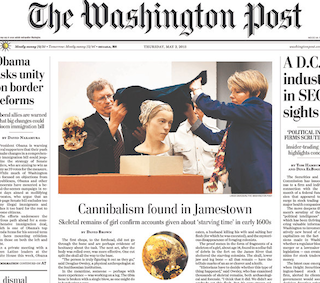
Jamestown: Cannibalism at Jamestown? On May 1, 2013, forensic evidence confirmed what survivors had reported: Colonists at Jamestown resorted to cannibalism during the winter of 1609-1610, known as the Starving Time. But the colony of Jamestown was troubled from the start.

There's also the Shipwreck that Saved Jamestown. When a relief mission left Plymouth in 1609 to assist the troubled colony of Jamestown, an intense storm separated one vessel from the rest of the fleet. Learn how this shipwreck may have saved Jamestown -- and inspired Shakespeare -- in this podcast.


Saturday, July 28, 2012

Summer #3-Primary Analysis: Edward Waterhouse

Opechancanough’s 1622 Uprising in Virginia-Edward Waterhouse, Declaration, 1622

Fifteen years after settling Jamestown, the Powhatan completed a surprise raid on the colonists.  Edward Waterhouse's Declaration explains to investors of the London Virginia Company exactly what took place, the losses, and the effects of the raid.  Until this time, the Colonists felt relations had been friendly (even if they would kidnap Powhatan leaders whenever they ran out of food, clean water, or other necessities, in order to force their neighbors to help).  
To decipher 17th century words that may be spelled differently, try pronouncing them aloud.

Background information on the raid is available from the Encyclopedia Virginia.

When students are finished reading, they should answer any or all of the following questions. 


Do not hesitate to ask your own questions, or even to question or comment on something one of your classmates may post.  The only things to remember are to avoid text-like phrasing, and to remain polite.

  1. What is the colonial reaction to the attack? Provide support.
  2. How was the attack prepared? How did the colonists survive?
  3. Why did Waterhouse suggest conquest was preferable to civility? Provide support.
  4. How might this Declaration have read, had Opechancanough written it? What evidence from The American Pageant supports this?

Friday, December 9, 2011

Primary Source and Character Analysis: John Brown


Consider the events involving John Brown from both Kansas and Harpers Ferry, VA. Then, please read the following reading, a letter written by Brown four days prior to his execution for treason. Then, consider the following question and comment: Was John Brown a hero and a martyr OR a madman? 


When commenting, you should provide your own personal insight, from readings, class, and comment on another person's response, tell whether you agree or disagree with that person, be sure to describe what about somebody else's previous comments do you agree/disagree with; base it on evidence.  Connect your responses to the content of chapter 19 (Chapter 20 in the 12th edition).


For more on John Brown's Raid, the following video was displayed at both the West Virginia and Virginia Historical Societies in 2009, the 150th anniversary of Brown's attempt to confiscate weapons from the arsenal in Harpers Ferry.