Please read the article Debunking Boston Tea Party Myths by Ray Raphael. Then read 2 of the differing accounts people had of the Boston Tea Party. After reading these, please comment in the comments section. To spur the conversation, consider the following prompts.
*How did the three items you read differ?
*What does the author want me to remember or learn from this passage?
*What is the most important information in this passage?
*One question I had about what I read was...
In a few days, come back and comment on somebody else's comments. Remember, keep it school appropriate and academic.
This must be completed by 11:59, Saturday, October 1, 2011
The 1960s — History.com Articles, Video, Pictures and Facts: "At the beginning of the 1960s, many Americans believed they were standing at the dawn of a golden age. On January 20, 1961, the handsome and charismatic John F. Kennedy became president of the United States. His confidence that, as one historian put it, “the government possessed big answers to big problems” seemed to set the tone for the rest of the decade. However, that golden age never materialized. On the contrary, by the end of the 1960s it seemed that the nation was falling apart."
The Other Rosenbergs - An investigation into discrimination against Jews who worked for the U.S. Army Corps at Fort Monmouth, NJ in the wake of Julius Rosenberg’s arrest.
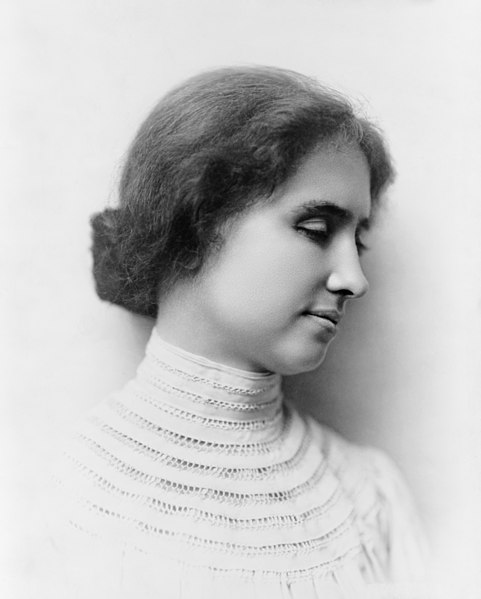
The story of how Helen Keller's teacher, Anne Sullivan, broke through the isolation of her disabilities, helping the girl communicate, has become widely known through the dramatic depictions of The Miracle Worker. Helen Keller is an inspiration, as she is the first person with both disabilities (deaf and blind) to earn a college degree. However, little attention is paid by most historians to her work as a political activist. Keller not only promoted progressive reforms, such as women's suffrage, but was an active socialist writer and lecturer. See Keller's file from the FBI.
Explore this side of her life. Analyze one of the following works by Keller. How does this relate to the progressivism of the time period? The Labor Movement? If you lived in the Red Scare, how might you react? Discuss the controversial nature of this, in comparison to America as a capitalist state.
Read this article. Post your response to the following question, or comment on other's responses
How does the article both demonstrate the social tensions and racism of America in the late 19th century as well as the changing workplace and working experience in America at that time?
The Assassination of President Abraham Lincoln: "Civil War Harper's Weekly, April 29, 1865
The April 29, 1865 edition of Harper's Weekly is a first edition description of the Assassination and Death of President Abraham Lincoln. We present below, for your research and perusal, the entire newspaper. Click on the thumbnails provided to be taken to the full, readable, rendition of that page."
Thoughts to consider:
Lincoln and JFK are often compared. The coincidences between them both are both uncanny and also flukish. Speak to your parents or grandparents, see if they remember when JFK was assassinated. Lincoln and JFK were charismatic leaders that weren't necessarily popular with the entire population, but certainly sought to enact a great deal of change. What kind of turmoil might a similar situation bring to the nation in the future? How might it have been worse considering the timing of Lincoln's assassination?
Finally, consider the words of Booth after shooting Lincoln, and their meaning: Sic semper tyrannis is a Latin phrase meaning "thus always to tyrants." It is sometimes mistranslated as "death to tyrants" or "down with the tyrant." While the phrase is attributed to Marcus Junius Brutus, the most famous figure in the assassination of Julius Caesar on March 15, 44 BC, it is more probably a later dramatic invention, as Roman historians of the period did not record it. In American history, John Wilkes Booth shouted the phrase after shooting President Abraham Lincoln on April 14, 1865, in part because of the association with the assassination of Caesar. Timothy McVeigh was wearing a T-shirt with this phrase and a picture of Lincoln on it when he was arrested on April 19, 1995, the day of the Oklahoma City bombing.The phrase was recommended by George Mason to the Virginia Convention in 1776, as part of the state's seal. The Seal of the Commonwealth of Virginia shows Virtue, spear in hand, with her foot on the prostrate form of Tyranny, whose crown lies nearby. The Seal was planned by Mason and designed by George Wythe, who signed the United States Declaration of Independence and taught law to Thomas Jefferson.
Please read the article's from Harper's Weekly, a popular American magazine during the 19th century: Southern Reaction to Emancipation Proclamation. Harper's Weekly (A Journal of Civilization) was an American political magazine based in New York City. Published by Harper & Brothers from 1857 until 1916, it featured foreign and domestic news, fiction, essays on many subjects, and humor. During its most influential period it was the forum of the political cartoonist Thomas Nast. By 1860 the Weekly’s circulation had reached 200,000. The article in question begins halfway down the first column, with the headline:
"HARPER'S WEEKLY.
SATURDAY, OCTOBER 18, 1862.
THE PRESIDENT'S PROCLAMATON IN SECESSIA."
It continues on to the following page. Please comment. Consider: The danger of reporting during the war, how such articles might affect the public perceptions of Lincoln, the war, and how they may be different depending on whether the reader was from the North, South, an immigrant, a free African America, pro-secession, an abolitionist, etc. Honestly, the positions to consider are endless.
Yesterday in class, we discussed regional dialects. One of the examples that came up was the discussion of soda, and what it is called in other parts of the country. Fast forward to today, and I found this article, discussing a study that is visually represented in the graphic below. Ironic.
Welcome to Mr. Pags' AP US History blog (PAGSAPUSH). My goal this year is to utilize this blog for online discussion, and to allow you all to post questions, comments, or concerns regularly regarding topics we'll be covering throughout the year.
This initial post is only a test. I'm curious to see who uses it, your thoughts, etc. I thought we could start with something simple. Recently, I watched a show on History Channel entitled How the States got Their Shapes. It was very interesting, and went over some obvious things (the use of rivers and other natural boundaries), and some things I had never heard before (for instance, regarding the state of Franklin named after Benjamin Franklin, or the Jefferson Territory which contained parts of various, current Rocky Mountain states).
These two were of particular interest to me as I watched. I have provided links to two short articles regarding these two defunct territories of the United States of America (I've confirmed the information in each article). Additionally, you should view the video regarding the State of Franklin's history. It was a documentary made by a student like you for the National History Day competition. Please reply with constructive comments and reactions to what you read, view. And, of course, please be as specific as possible.