The Final Countdown To...

Showing posts with label Colonial. Show all posts

Thursday, June 12, 2014

Summer Blog Post #3-Mayflower Compact

This bas relief depicts Signing of the Mayflower Compact, and is located at the Pilgrim Monument, Provincetown, MA


Having read Chapters 2 and 3, you're familiar with the Separatists (the Pilgrims, as they're more commonly known) who settled Plimouth Plantation.  Did you know that in 1620, the Pilgrims spent five weeks exploring Cape Cod before they sailed to Plymouth, Massachusetts. By the time this posts, I will have spent a little over 10 days nearby.


I digress. After spending weeks at sea, the Pilgrims resolved not to set foot on land until the Mayflower Compact was written and signed. The Mayflower Compact is the first instance of a democratic society in the New World.You should also be knowledgeable of the Puritans that settled Massachusetts Bay Colony (and, eventually, Hartford and New Haven), once you've completed the readings of Chapters 2 and 3.  They're an interesting bunch that evolved in 


The Mayflower Compact is a significant document in American history.  Additionally, the influence of the General Laws of the colony, as well as other New England colonies is still visible today.

Ouch.


The Assignment

A. Read the Mayflower Compact (1620).  Then read The Book of the General Laws (1685).There is a question at the start, but there is also an answer at the end.  They're valuable, but not necessarily what we're going to look at as a class.

B. Consider the two documents.  Answer the following questions in the form below, and submit them to Mr. Pagliaro.


This is worth 25 points towards a student's quarterly average.


Tuesday, August 20, 2013

Summer Assignment #6

Columbian Exchange - The positives and negatives of the Age of Exploration


To help students in the 2013-14 APUSH class make sense of Chapter 2 in Lies My Teacher Told Me (1493-The True Important of Christopher Columbus), answer any of the following questions.  Do not hesitate to ask your own questions, or even to question or comment on something one of your classmates may post.  The only things to remember are to avoid text-like phrasing, and to remain polite.

The Assignment
A. Read the chapter from Lies My Teacher Told Me.

B. Following the commenting guidelines, answer ANY of the following questions (choose 3 or 4, please do NOT answer all of them), and respond to them in the comments section of this post.

As you read through 1493 in Lies...
  1. One question I had about what I read was....
  2. What were you thinking about as you were reading? Can you reconcile this version of Columbus with the others you've read or learned?
  3. What question(s) can you ask about what you read?
  4. While I read, I was curious about...
  5. What words or ideas need clarifying for you?
  6. What does the author want me to remember or learn from this passage?
  7. What is the most important information in this passage?
  8. What kind of “teacher” question can I ask about the main idea?
  9. In my own words, this is about ...

C. Return in a few days and read through the responses of others. Again, following the commenting guidelines, provide feedback, criticism, or ask questions. Also, if somebody responds to your comment, feel free to comment back, of course, being polite. It will help promote positive dialogue in class later this year.


Both B & C must be completed to earn full credit for the assignment.

Thursday, August 15, 2013

Supplemental: The Quakers, the Dutch, and the Ladies: Crash Course US History #4

John Green and the folks at Crash Course do an excellent job discussing the settlement of Dutch New Netherland (New York, after Peter Stuyvesant gave up!), and the English proprietary colony of Pennsylvania.  It's a good review, and helpful in an entertaining way. Enjoy, and you might just learn something.

Saturday, August 10, 2013

Summer Assignment #5-A Model of Christian Charity Excerpt-John Winthrop, 1630


The Winthrop Fleet was a group of eleven sailing ships under the leadership of John Winthrop that carried approximately 700 Puritansplus livestock and provisions from England to New England over the summer of 1630. The Puritan population in England had been growing for many years leading up to this time. They disagreed with the practices of the Church of England, whose rituals they viewed as superstitions and attempted over many years to modify religious practice in England to conform to their views. King James wished to suppress this growing rebellious movement. Nevertheless, the Puritans eventually gained a majority in Parliament. James' son King Charles came into the greatest possible conflict with the Parliament, and viewed them as a threat to his authority, temporarily dissolving parliament in 1626, and again the next year, and finally dissolving parliament permanently in March 1629. Motivated by these political events, a wealthy group of leaders obtained a Royal Charter in March 1629 for a colony at Massachusetts Bay.
 The initial migration took three phases.  A fleet of five ships had departed a month previously for New England that included approximately 300 colonists, led by Francis Higginson.  Later that year, the remaining investors elected John Winthrop as governor, who then led a fleet of 5 ships, followed by 6 more several weeks later, totaling nearly 700.  Additionally, an existing settlement, Salem, was established in 1626.  Winthrop's colony and authority extended control over Salem, previously run by John Davenport.
The Great Migration of Puritans to New England continued for nearly a decade. They came in family groups, rather than as isolated individuals, and were motivated chiefly by a quest for freedom to practice their Puritan religion.
 Meanwhile, other Puritans and members of Parliament, namely Oliver Cromwell, fought a series of civil wars from 1642-1651. They deposed, tried, and eventually executing Charles I.* The English Civil War led to the establishment of a Commonwealth government that lasted until 1660, and the Puritan-dominated Parliament actually banning Christmas celebrations.
The above information was modified from various Wikipedia entries. 
 
The execution of Charles I


John Winthrop's Model of Christian Charity - delivered on board the Arbella as members of the Massachusetts Bay Colony sailed toward the New World - describes the struggle of Puritans and their "errand into the wilderness." Their struggle? How can a group of outcasts who have a habit of quarreling with authority construct a strong society without fighting amongst themselves?

As you know from your reading of Chapter 3, John Winthrop (1588-1649) was governor of the Massachusetts Bay Colony - a group that left England in search of trade opportunities in the New World. Like most members of the Colony, Winthrop was a Puritan. This group claimed that the Church of England was corrupted by selfish leaders and petty squabbles. In contrast, Puritans envisioned an idealized community in which all citizens would focus their lives on the word of God. Ironically, the Puritans' almost single-minded pursuit of a perfected society based on biblical teachings resulted in impressive success in secular affairs. This success is often explained by the so-called "Puritan Work Ethic" - the ability to sacrifice personal ambitions for larger goals. Puritans also believed that they could be a blessed people - chosen by God to set an example for others.

Both of these aspects have Puritan New England, and Winthrop's sermon have infused themselves into the American Identity. What it means to be an American, for generations, has involved hard work (especially on the East Coast [though, since the 18th century, this has constantly been diminished by increased technology]). Furthermore, the idea that the Puritan community that settled Massachusetts Bay Colony in 1630 was to be an example for others to follow has truly been one of the things that America has stood for since that time, and increasingly so since the American Revolution. To this day, the United States of America constantly redefines how it will be an example to others, whether through its own actions, or acting on the behalf of other peoples and nations. Some might not like it, but it is truly, what the identity of the United States of America has become: hence, American Identity.
The Assignment
A. Read the excerpt from John Winthrop's A Model of Christian Charity, in regards to being a "City upon a hill."  

B. Following the commenting guidelines, answer ANY of the following questions (choose 2 or 3), and respond to them in the comments section of this post.


  1. To what extent did John Winthrop’s “A Model of Christian Charity” provide a powerful and workable founding vision for his colony? For what would become the United States of America?
  2. What does John Winthrop’s “Model of Christian Charity” sermon explain about the beliefs and goals of the Puritans?
  3. One way to read the lay sermon A Model of Christian Charity is as a kind of a “peptalk” or “motivational speech.” What points does Winthrop seem to want to make his audience feel good or motivated about?
  4. The most lasting, final image from A Model of Christian Charity is that of the “city on a hill."  Think carefully about this image. What sorts of things does it suggest to you, literally—that is, what is important about a literal city on a literal hill? Then, think about why Winthrop is turning to that image in this particular context—what does he want to suggest about his Puritan community and their sense of mission? 
  5. The phrase “city on a hill” is still used by politicians today in speaking about America. Why? What does this image still suggest about America’s conception of itself?
C. Return in a few days and read through the responses of others.  Again, following the commenting guidelines, provide feedback, criticism, or ask questions.  Also, if somebody responds to your comment, feel free to comment back, of course, being polite.  It will help promote positive dialogue in class later this year.

Both B & C must be completed to earn full credit for the assignment.

Thursday, August 1, 2013

Supplemental: When is Thanksgiving? Colonizing America: Crash Course US History #2


John Green and the folks at Crash Course do a nice job of reviewing chapters 2 and 3 in a visually stimulating, and entertaining way.  It also is really really informative. Enjoy!

Wednesday, July 31, 2013

Summer Assignment #4-Plymouth, the Mayflower Compact, and The General Laws of 1685

This bas relief depicts Signing of the Mayflower Compact, and is located at the Pilgrim Monument, Provincetown, MA


Having read Chapters 2 and 3, you're familiar with the Separatists (the Pilgrims, as they're more commonly known) who settled Plimouth Plantation.  Did you know that in 1620, the Pilgrims spent five weeks exploring Cape Cod before they sailed to Plymouth, Massachusetts. By the time this posts, I will have spent a little over 10 days nearby.

I digress. After spending weeks at sea, the Pilgrims resolved not to set foot on land until the Mayflower Compact was written and signed. The Mayflower Compact is the first instance of a democratic society in the New World.You should also be knowledgeable of the Puritans that settled Massachusetts Bay Colony (and, eventually, Hartford and New Haven), once you've completed the readings of Chapters 2 and 3.  They're an interesting bunch that evolved in 

The Mayflower Compact is a significant document in American history.  Additionally, the influence of the General Laws of the colony, as well as other New England colonies is still visible today.
Ouch.


The Assignment
A. Read the Mayflower Compact (1620).  Then read The Book of the General Laws (1685).There is a question at the start, but there is also an answer at the end.  They're valuable, but not necessarily what we're going to look at as a class.

B. Consider the two documents.  Answer the following questions in the form below, and submit them to Mr. Pagliaro.


This is worth 25 points towards a student's quarterly average.


Tuesday, July 23, 2013

Supplemental: Interesting history about the Southern Colonies


One of my favorite things is to learn interesting tidbits of history.  When driving, many people listen to music. I listen to enough music while I run, so I often listen to podcasts in the car.  One of my favorites is titled "Stuff You Missed in History Class."  When something can be applied to class, I try to share it.  Throughout the year, I use the podcasts as a forum for extra credit in APUSH.  Often, the hosts will read listener mail, and it's not uncommon for an APUSH or college student to mention using the podcasts to supplement and enhance their knowledge.  So, feel free to subscribe to it on iTunes.  It's pretty great.  You can also follow the show and its hosts on twitter, @MissedinHistory.In American colonial history, there have been several great episodes of late.  So, I'll share them below.Roanoke: What happened to the lost colony of Roanoke (w/ Update)?Of all the mysteries we've covered, the lost colony at Roanoke is one of the strangest. In this classic episode, former hosts Candace and Josh recount Roanoke's story -- and there's a new development, one that may finally reveal the fate of the colonists.

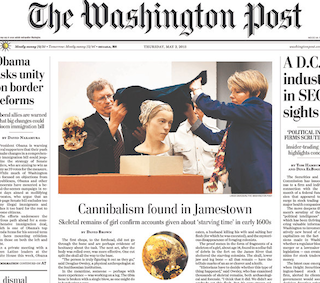
Jamestown: Cannibalism at Jamestown? On May 1, 2013, forensic evidence confirmed what survivors had reported: Colonists at Jamestown resorted to cannibalism during the winter of 1609-1610, known as the Starving Time. But the colony of Jamestown was troubled from the start.

There's also the Shipwreck that Saved Jamestown. When a relief mission left Plymouth in 1609 to assist the troubled colony of Jamestown, an intense storm separated one vessel from the rest of the fleet. Learn how this shipwreck may have saved Jamestown -- and inspired Shakespeare -- in this podcast.


Thursday, July 11, 2013

Summer Assignment 2013 #2-Bartolomé de Las Casas on the Destruction of the Indies

Bartolomé de Las Casas was a 16th-century Spanish historian, social reformer and Dominican friar. He became the first resident Bishop of Chiapas, and the first officially appointed "Protector of the Indians". His extensive writings, the most famous being A Short Account of the Destruction of the Indies and Historia de Las Indias, chronicle the first decades of colonization of the West Indies.


de Las Casas


The Assignment
A. Read the excerpt from ...The Destruction of the Indies..  There is a question at the start, but there is also an answer at the end.  They're valuable, but not necessarily what we're going to look at as a class.

B. Following the commenting guidelines, answer ANY of the following questions (choose 1 or 2), and respond to them in the comments section of this post.

  • What motivations may have led to the way Spaniards affected the native Caribbean population as they did?  What motivated Spanish colonists?
  • What personal motivations might have led de Las Casas to petition the Spanish crown for leniency towards Native Americans?
  • Encomienda was a legal system that was employed mainly by the Spanish crown during the Spanish colonization of the Americas to regulate Native American labor. What are your impressions of the encomienda system? Be very specific; avoid being general.
C. Return in a few days and read through the responses of others.  Again, following the commenting guidelines, provide feedback, criticism, or ask questions.  Also, if somebody responds to your comment, feel free to comment back, of course, being polite.  

Both B & C must be completed to earn full credit for the assignment.

Monday, July 1, 2013

Summer Assignment 2013 #1-Columbus' Letter to Spain's Treasurer

Raphael Sanchez was the treasurer of Spain for Queen Isabella of Castille and King Ferdinand of Aragon.  This short letter to Sanchez details his original journey to the Caribbean in 1492, after his return to the port of Lisbon in modern Portugal.  Columbus addressed it, "Letter addressed to the noble Lord Raphael Sanchez, Treasurer to their most invincible Majesties, Ferdinand and Isabella, King and Queen of Spain, by Christopher Columbus, to whom our age is greatly indebted, treating of the islands of India recently discovered beyond the Ganges, to explore which he had been sent eight months before under the auspices and at the expense of their said Majesties." That's a mouthful.

At the same time, it leaves some confusion, as whether Columbus recognized his mistake yet, or not.  In the address, he describes the islands he explored as "of India...beyond the Ganges."  Columbus refers to the Island of Juana.  Today, we refer to that island as Cuba.  San Salvador, the island Columbus first arrived at in the Caribbean, was already settled by the Taino who called their island Guanahani.  The Taino were a part of the greater group of Natives known as the Arawak.  For a time in the 1600s to 1925, this island was called Watlings island, and is part of the Bahamas.  Today, it is called San Salvador, again. When will it be Guanahani (or Guanahany) again?

The Assignment
A. Read the letter.  There is a question at the start, but there is also an answer at the end.  They're valuable, but not necessarily what we're going to look at as a class.

B. Consider the letter.  Answer the following questions in the form below, and submit them to Mr. Pagliaro.


For your viewing pleasure, this might help when you've completed the readings on Columbus, as well.

Thursday, September 6, 2012

Primary Analysis #4 - Roger Williams


Examine the letter written by Roger Williams.  Then, comment on it, sharing your thoughts.

  • Which themes in the letter relate back to the themes and ideas within the Chapter 3 reading?  
  • List 2 things within the letter you thought were important ideas relating back to Unit 2?  
  • What does the document reveal about life in the United States in the time it was written?  What evidence within the document demonstrates this?